Showing posts with label sojourner truth. Show all posts

Sunday, 19 October 2014

We Know We're Being Conned

In a week or so, our latest album will be mixed, and we'll be starting to work towards a release date. Lots of work and money goes into it this stage - creating artwork, getting CDs designed and produced, arranging some kind of PR strategy (or paying someone else to), trying to arrange live dates and a possible tour around its release, and in our case, making sure we get all the merch ready to honour our Pledge campaign. It's a necessary though not particularly interesting period in the process. In fact, it's the antithesis of writing, playing and performing - all the bits of being a musician that you actually get a kick out of.

That's probably why my mind has started to wander towards the next record. This evening I was reading an excellent article on black conmen in antebellum New York, who practiced "burning": ripping off whites with counterfeit notes. The article was smart and well written, by an Australian chap called Shane something or other (I haven't got the article to hand), and he was developing a thesis about free African Americans and their relationship with money (I'm paraphrasing; it's a lot smarter than that). It got me thinking, firstly, that 'Burning' is a good song title, and secondly, that some of these characters are definitely worth writing about. Then, I realised that I've got a few song ideas about New York in the 1830s that I've been wanting to write about: The unsolved murder of Mary Rogers (The Beautiful Cigar Girl); the Moon Hoax; Sojourner Truth and her involvement with a religious cult in upstate New York; some Paine-ite newspaperman who I can't remember much about but sounded interesting. Oh, there are loads of them; stories I've wanted to write and develop but never got round to. Then I thought, what if they all converge on one day in the city,  the stories weaving in and out of one another, passing but never quite seeing each other. It's a bit of a stretch as a lot of these stories are 5 or 6 years apart, but what the hell, I've been anachronistic plenty before in my songs, I can pull it off again.

I also thought, I'd really love to write these lyrics down without playing a note, and then just taking them to the band and see what they do with the material. I've never really done that before and it kind of excites me as a new idea, and is bound to produce melodies I wouldn't otherwise find.

I read something last week that suggested that voters in this period, despite what historians have suggested,  were engaged with the political process, not through a deep understanding and passion for participatory democracy, but with a knowing irony that essentially they were being duped, conned by a wealthy political class. There's probably only a morsel of truth in it, but the idea is too good, and at its very genesis, I love the thought of imbuing the project with that wry fucking smile. We know we're being conned. 

Monday, 17 December 2012

Corlears Hook

With the build-up to our album launch in January and our tour in February, I must admit that I have been a little distracted from my main objective - to write songs. However, I was recently compelled to write something on a story I came across in a book on artisan organisation in New York City during the early republic. The story was brief - only a few lines - and was about a boy who had run away from his sick parent. As with a number of other songs I've written, this unfinished tale got me wondering what became of him.

All we know, from the account by Reverend Ezra Stiles Ely, is that the boy had absconded from his parent, who was an invalid at the New York Alms House. Ely, who in 1812 was chaplain of the Alms House, was doing his rounds through the city. Asking after the missing boy, he was told to visit a cobbler living in one of the city's many cellar dwellings. Here, Ely found the boy, alongside a mournful cobbler and his family. He had kept the boy for a week but could no longer do so, "because he was too small to sit on the bench of the profession." Ely took the boy back with him. The cobbler, in justification said, "he cannot earn anything yet." The unnamed tradesman was left with a stark choice: a sentimental gesture towards one of the city's many destitute children, or feed his family. This incident was set against a backdrop of huge upheaval for the city's trades, particularly the 'small masters', who in the wake of the "commercialization of trade" from New York's expanding economy (soon to be the country's leading port city), were left clinging to a dying tradition.

(Incidentally, Ely features in one of my earlier songs, Julia Died of Cholera, when he comes up against congressman Richard Johnson, who fought for Sunday mail deliveries to remain in place, despite numerous petitions from Christian preachers like Ely who saw it as a violation of the Sabbath. Wonderfully, Johnson said, "Stop [the mail] one day in seven, and you retard one seventh of the advancement of our country.")


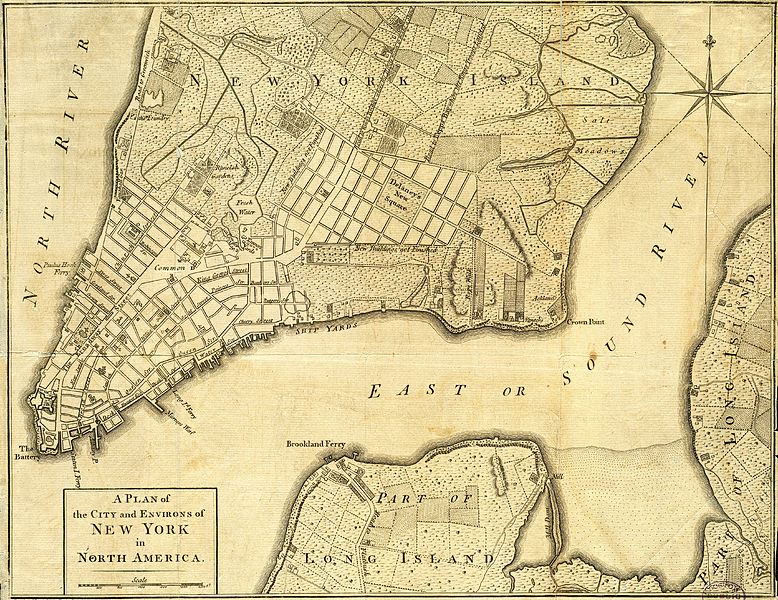
Corlears Hook, named Crown Point, during the British occupation of the city during the Revolution

But what of the boy? Born into poverty, his options were limited. It is possible that he would have returned again to the Alms House, but more likely, given the boy's independent spirit, he could just as easily ended up looking for work in the rough and lively area of Corlear's Hook (beyond what is now the Lower East Side), perhaps Walnut Street, with "its grogshops, ballrooms, and bawdy houses, enticing young mechanics, sailors and drifters." Perhaps he became the young boy employed by a baker to sell cakes and pies in the street, who was caught spending the profits to "have connection" with a young streetwalker. Whilst ministries attempted to stem the tide of depravity as they saw it, the residents enjoyed numerous forms of recreation: cockfighting, bull-baiting, alongside shows from travelling musicians, daredevils and acrobats. Celebrations such as these - including heavy drinking and gambling - provided ample relief from a hard day's work. Our young man initially returns then to the cobbler who housed him briefly, only to find him no longer there, having moved his family to the western New York, to tramp, to find more work.

What happens next I'm not entirely sure. In what could become an epic, Flashman-style tale of travel and adventure, I'm both excited and wary of this potentially picaresque tale. I see our adventurer travelling throughout  New York, helping build the Erie Canal, listening to Charles Finney preach, meeting Sojourner Truth, Martin Van Buren, Joseph Smith, shaping events unwittingly.  

For now, he remains in Corlears Hook, and so does the song.

Quotes are taken from Chants Democratic by Sean Wilentz.