Monday, 27 May 2013

The burning of Pennsylvania Hall

Pennsylvania Hall, a purpose-built abolitionist meeting place, was opened on 14th May, 1838, in Philadelphia. Four days later, it was burned to the ground by an angry white mob. As seen in the picture below, thousands gathered to cheer and take part in its destruction, beating the fleeing African Americans. Note also the fire company's hose directed at the adjacent building. I've been looking into this story as a subject for a song and I came across this interesting account in the diary of the New York merchant, Philip Hone:

"Friday, May 18. - Riot in Philadelphia. Our neighbouring city of Philadelphia was disgraced yesterday by a riot which ended in the destruction of Pennsylvania Hall, a place of meeting for the discussion of Abolition questions. A meeting was held in the forenoon and speeches were made, which exasperated the mob; another meeting was to have taken place in the evening, but it was prevented by the interference of the mayor. The mob, still farther instigated, it is said, by the wanton outrage of public opinion in the exhibition in the public streets of white men and women walking arm in arm with blacks, assembled in greater numbers in the evening, broke into the hall, destroyed everything they could find, and set fire to the building, which was entirely destroyed by ten o'clock. The excitement was so great that the mayor and other officers were unable to prevent the outrage, and some of the number (particularly Mr. Watmouth the sheriff) were dangerously wounded. A large proportion of the Abolitionists assembled in the hall were females, of whom several harangued the meeting, and were foremost in braving the excited populace. This dreadful subject gains importance every day, and reflecting men see in it the seeds of the destruction of our institutions."

Feeding into another of my songs ('Paris of America'), Hone visits Philadelphia for a wedding a month later and takes an interest in the Fairmount Water Works:

"The grounds, gardens fountains, pavilions, etc., are all in beautiful order, and appeared at this season, when nature is clothed in all her loveliest attire, and the day unusually bright, to greater advantage than I have ever seen them. The walks were filled with well dressed and well behaved people, who appeared to be of the better sort of bourgeoisie. Groups of young persons, male and female, were seated on the grass, and in the different pleasant pavilions, and the whole scene reminded me of the suburbs of a French city on a fine Sunday afternoon."


Sunday, 12 May 2013

Paris of America

Last night, we debuted two new songs at The Harley in Sheffield. Certainly one of them will most likely appear on our next album, which you may or may not have read in previous posts, will be an exploration of Philadelphia in the 1840s and 50s. The newest of these is still a work in progress and takes the perspective of Robert Purvis, a black abolitionist leader, who, following a riot in which houses and churches of African Americans were burned and destroyed, walks through the destruction. The riot had begun when the parade of the Negro Young Men's Vigilant Society was attacked, as they celebrated the abolition of slavery in the West Indies. Rioting lasted for two days before the militia stepped in.

The song itself isn't about the riot as such but more the aftermath and the impact it had on Purvis. After the riot, he wrote in a letter to white abolitionist Henry C. Wright, "Press, church, magistrates, clergymen and devils are against us... I am convinced of our utter and complete nothingness in public estimation." That sentiment of dejection struck me, and I wanted to in some way to portray someone who feels hated by so many people around him, completely separated from justice or any belief in fair treatment by the authorities. Purvis felt the stinging injustice of Philadelphia's treatment of its black population and the comment above feels like a point of desperation. As in so many of my songs, I'm imagining what someone might be feeling and one theme I explore is the idea of a how he might have imagined revenge. Purvis supported temperance societies and women's suffrage and undoubtedly never saw violence as a means to enfranchisement. Indeed, he appealed to the state legislators to turn back recent state laws that deprived blacks of the vote in his "Appeal of Forty Thousand Citizens Threatened with Disfranchisement." However, as with a lot of my songs, I'm looking for the unseen or undocumented possibilities. The character in this song, in his "darkest hour", imagines an "orgy of violence" as he torches "the city that scorns him." The opposition that Purvis faced in his attempt to restore the rights of the black population was in some way informed by a fear of a black uprising, following Nat Turner's violent slave rebellion in 1831, which panicked the white population throughout the country.

'Paris of America', the more complete of the two new songs, looks at the bourgeois fear of an uprising from the city's violent and "savage" poor. Characterised as such by both the wealthy and the missionary portions of the city, plans to beautify the city with boulevards and fountains were one way of civilising what they saw as a degraded underclass. Consolidation of the city and its suburbs in 1854 also brought with it a police force with greater powers in an attempt to bring this violent period to a close. As in other growing urban populations, dramatised accounts of violence gratuitously sensationalised the participants and it is this perspective the song takes. The narrator acts somewhat like a tour guide taking a gentleman and his lady through the "slum" area of Bedford (which was grotesquely characterised in the picture above by the Bedford Street Mission), warning them of the dark unseen underbelly, "just around the corner", as Bedford Street was indeed just a few blocks from the grand Broad Street.

As many of the paintings of sketches of Philadelphia around this period were more often intended as a postcard to promote a grand and sophisticated metropolis (see the painting to the left of Chestnut St), I thought it would be interesting to recreate sketches of streets like Bedford in a more realistic way, if that is possible, and it's something I'm looking into for our project. For the time being, these are two of the "hooks" of Philadelphia I've found and managed to create a couple of different perspectives from. In terms of giving a broad view of Philadelphia life, I'm hoping to continue writing about the distinctive cast of characters that make up this heterogeneous urban metropolis. It's certainly what makes the city such a fascinating subject.

Sunday, 24 March 2013

Faith & Fear In Philadelphia

Last summer, I had the good fortune to get to know some historians at the University of Sheffield. No doubt intrigued that we were writing songs on 19th Century American characters and events, they asked me, over a beer or two, if we would be interested in doing a project with the History Department. I said yes, and we started planning what that would entail. At the end of January, Andrew Heath, lecturer in American history and our partner for the project, submitted a bid to a public engagement fund called the Arts Enterprise based within the Faculty of Arts & Humanities at the University. A couple of weeks later, we were told our bid had been successful and our project would be funded in full.

So what exactly is our project?

Before we went into the studio to record our first album, I already had in mind a loose idea for our second record. The Mule & The Elephant was a collection of songs written over a few years; some written three years before, some a couple of weeks old. Though I think they sit together well on the album, the songs travel through time and space and this creates a particular effect. The album moves geographically from the Erie Canal to Oregon; crossing the Mississippi with the Mormons and holed up with Thomas Jefferson on his death bed in Monticello. Crossing the continent back and forth, as an exploration of the nation's ambitions, suitably frames the story. The grand themes required that 'big picture' and this is seen in the stories that we explore too. As our liner notes illuminate, moving "from Presidents to railroad tramps" emphasises the rapid change occurring in the nation as industrialisation changed forever the lives of working people and the political divisions became more pronounced. Eventually, after the mania of a religious revival and the persecution of a growing sect and the drownings and poverty and political vanity, we can hopefully stand back and say it makes some kind of sense.

It was from this frenetic state that I was looking to find a home to settle in for a while. I wanted one place for  my next collection of songs. I wanted them to be concentrated, not just in the absorption of a locale but within a close period of time too; for them to be have a cohesion that was reflective of an intense period of songwriting. I spoke to Andrew about this and he eventually convinced me Philadelphia had the requisite components for the subject of an interesting album.

He's right, too. Like other growing urban spaces in the US, Philadelphia's experience of industrialisation created a number of unsettling anxieties in its populace. Whilst revivalism had stretched to the city, most notably manifested in the preaching of ministers like Albert Barnes, the dominant strain of Protestantism became preoccupied with anti-Catholicism, which culminated in one of the city's most violent riots in 1844. This was seized on by the newly formed Native American Party, who stoked the fires of anti-immigrant sentiment. Ironically, this dissipated after the influx of Irish immigration from 1848 onwards. For African Americans, the city of brotherly love was a popular destination point for runaway slaves and free blacks. Although a black upper class developed with its own institutions of education and benevolence, quality of life deteriorated dramatically for the vast majority during the years after 1838, when free blacks lost their right to vote. An increased population did nothing for the cause of African Americans as they lost their jobs to immigrant Germans and Irish, and hostility towards them caused one visiting English Quaker to comment that "Philadelphia appears to be the metropolis of this odious prejudice and that there is probably no city in the known world where dislike, amounting to hatred towards the coloured population prevails more than in the city of brotherly love!" Such was their desperate plight, black leader Robert Purvis became so downhearted as to observe that "press, church, magistrates, clergymen and devils are against us... I am convinced of our utter and complete nothingness in public estimation." Violence followed blacks in every public arena, such as when the Negro Young Men's Vigilant Association paraded to commemorate the abolition of slavery in the West Indies. Beatings, lootings and the destruction of homes were commonplace for the African American in Philadelphia during the 1840s.
These strains of violence and religion are concurrent themes in antebellum Philadelphia and are what drew me to the city. Our project then, will be an exploration of this changing metropolis and how it emerged from this period of turmoil. A collection of songs will come out of this research and will form our second album, though the recorded output is just one element of this project. We're also working with film-makers Optical Jukebox, who will chart the process of the project and bring to life some of the themes in a short film. We'll be holding a series of events throughout the next year and a half, working with Sensoria, discussing history as a subject of music and engaging in debates on urbanism and the common issues that cities face, not least our own city of Sheffield.


For my own part, the project begins now, as I delve in Philadelphia's past and attempt to bring about a narrative that can be interesting, exciting and provocative. One of the (semi) completed songs that we have been playing in rehearsal has the tentative title, 'Paris of America'. This, in one way, is close to the end of the story. The city's patricians theorised on how to civilise the poor of their violence and depravity. Build parks, fountains, boulevards and the regenerative power of this new environment will transform, it was suggested. This bourgeois fear of the violent underclass, of even a potential uprising against the elite, was real and tangible. Like many of our contemporary public debates, it is another question gone unanswered and one that has been with us throughout history: what are we to do with the poor? It isn't hard to to think back to a year and half ago, when London was burning, and to remember both the inane and the insightful answers to this question. History continues to remind us of our collective amnesia.


Credit must go to Andrew Heath, whose research is informing the project and much of the detail about Philadelphia in the post above, as well as Elizabeth M. Geffen's chapter 'Industrial Development and Social Crisis 1841-1854' in Philadelphia: A 300 Year History, from where I found the quotes.

Sunday, 23 December 2012

Thomas P. Cope

I've been dipping into the diary of Thomas P. Cope, a Quaker merchant from Philadelphia in the first half of the 19th Century. His observations are fascinating and like many letters of the time, can be beautifully poetic. He speaks a lot of his business, the weather, his ailments but also of contemporary events. This evening I read this entry from September 22nd, 1800 and although I'm unlikely to write a song out of it, I felt the need to share it.
"A conspiracy of the negroes has been detected at Richmond. Several of the unhappy wretches have been executed & others are expected to suffer the same fate. So long as seven thousand fellow beings are held in chains in these United States, their cruel & hardened oppressors may look for plots, conspiracies & insurrections. Nature revolts at the idea of bondage in any shape, but when that bondage is attended with other circumstances of barbarity such as tearing a fond husband from the arms of an affectionate wife & forcing the smiling babe from the breast of a tender hearted mother, of severing whole families & cutting asunder all the dearest ties of humanity, of dragging those innocent & hapless victims into a far and distant country, never, never to return, but to endure every species of heart rending torture under the galling yoke of a never ending slavery, except by the welcome interposition of death; surely those forgers of fetters, these tyrants of their species, are not to expect from men, formed, like themselves, for the sweet enjoyments of liberty, a tame and unresisting submission to all their deeds of merciless injustice. I would not be a dealer in flesh for all the riches of Indastan; nor a master of slaves for the fairest portion of my country. When I contemplate the nature of man, his restless spirit & daring efforts to regain that state of freedom of which he is wantonly deprived by his fellow man, I think I can see, in the sullen temper & discontented acts of the negroes in the southern states, a gathering storm, which may one day burst forth & overwhelm the oppressor & the oppressed in one general indistinguishable ruin."

Monday, 17 December 2012

Corlears Hook

With the build-up to our album launch in January and our tour in February, I must admit that I have been a little distracted from my main objective - to write songs. However, I was recently compelled to write something on a story I came across in a book on artisan organisation in New York City during the early republic. The story was brief - only a few lines - and was about a boy who had run away from his sick parent. As with a number of other songs I've written, this unfinished tale got me wondering what became of him.

All we know, from the account by Reverend Ezra Stiles Ely, is that the boy had absconded from his parent, who was an invalid at the New York Alms House. Ely, who in 1812 was chaplain of the Alms House, was doing his rounds through the city. Asking after the missing boy, he was told to visit a cobbler living in one of the city's many cellar dwellings. Here, Ely found the boy, alongside a mournful cobbler and his family. He had kept the boy for a week but could no longer do so, "because he was too small to sit on the bench of the profession." Ely took the boy back with him. The cobbler, in justification said, "he cannot earn anything yet." The unnamed tradesman was left with a stark choice: a sentimental gesture towards one of the city's many destitute children, or feed his family. This incident was set against a backdrop of huge upheaval for the city's trades, particularly the 'small masters', who in the wake of the "commercialization of trade" from New York's expanding economy (soon to be the country's leading port city), were left clinging to a dying tradition.

(Incidentally, Ely features in one of my earlier songs, Julia Died of Cholera, when he comes up against congressman Richard Johnson, who fought for Sunday mail deliveries to remain in place, despite numerous petitions from Christian preachers like Ely who saw it as a violation of the Sabbath. Wonderfully, Johnson said, "Stop [the mail] one day in seven, and you retard one seventh of the advancement of our country.")


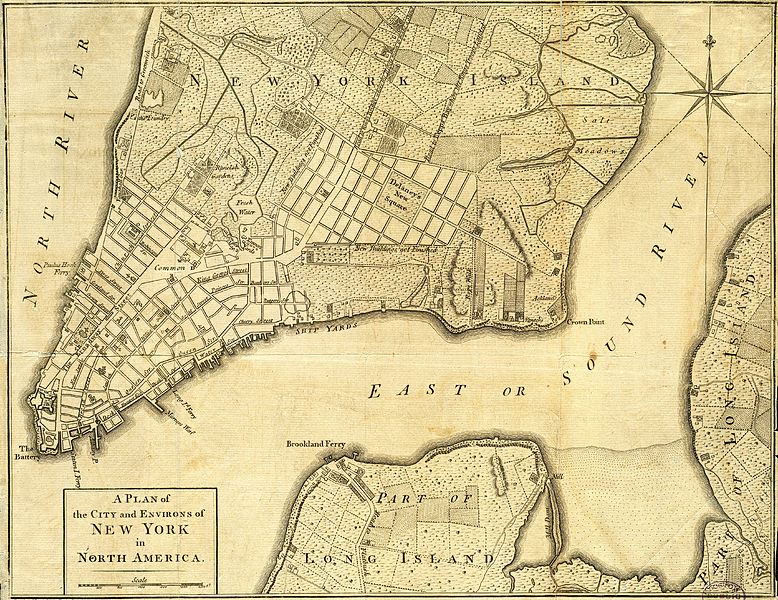
Corlears Hook, named Crown Point, during the British occupation of the city during the Revolution

But what of the boy? Born into poverty, his options were limited. It is possible that he would have returned again to the Alms House, but more likely, given the boy's independent spirit, he could just as easily ended up looking for work in the rough and lively area of Corlear's Hook (beyond what is now the Lower East Side), perhaps Walnut Street, with "its grogshops, ballrooms, and bawdy houses, enticing young mechanics, sailors and drifters." Perhaps he became the young boy employed by a baker to sell cakes and pies in the street, who was caught spending the profits to "have connection" with a young streetwalker. Whilst ministries attempted to stem the tide of depravity as they saw it, the residents enjoyed numerous forms of recreation: cockfighting, bull-baiting, alongside shows from travelling musicians, daredevils and acrobats. Celebrations such as these - including heavy drinking and gambling - provided ample relief from a hard day's work. Our young man initially returns then to the cobbler who housed him briefly, only to find him no longer there, having moved his family to the western New York, to tramp, to find more work.

What happens next I'm not entirely sure. In what could become an epic, Flashman-style tale of travel and adventure, I'm both excited and wary of this potentially picaresque tale. I see our adventurer travelling throughout  New York, helping build the Erie Canal, listening to Charles Finney preach, meeting Sojourner Truth, Martin Van Buren, Joseph Smith, shaping events unwittingly.  

For now, he remains in Corlears Hook, and so does the song.

Quotes are taken from Chants Democratic by Sean Wilentz.

Saturday, 29 September 2012

The Golden Book

It's been over a month now since we recorded our album and we're due to get the final mix in the next few days. In the meantime, we've been busying ourselves trying to sort out tour dates, looking at artwork options, doing a river baptism photoshoot (pictured) and generally plotting here and there about what we want to do with the album. Although fun, it quickly reminds me of what I need to soon get back to and it seems a long time since I actually wrote a song. I wrote a short song called The Golden Book just before we went into the studio, which was a song about revenge and redemption from the perspective of a prisoner of war who is confused by where to direct his anger. The protagonist reverses his role by becoming the torturer to an innocent victim. It's a brutal tale, and my hope was to explore that idea of someone trying to find relief in revenge.
Where that fits into future projects, I'm not yet sure, as I'm now moving onto writing our next album. My idea is to write a very focused canon of songs which all take place in one town in Western New York in the 1820s and 1830s. I've touched on the Burnt Over District a little before in previous songs and that period is certainly the most interesting to me in American history. Whether I write self-contained stories or try and produce a clearer narrative throughout the songs is something I'll discover in the writing process - or more likely, the research process.

I'm also very lucky to have recently befriended some fantastic people in the History department at the University of Sheffield, who we're hoping to collaborate with at some point. I've received some great reading recommendations and I've just started on What Hath God Wrought: The transformation of America 1815-1848  by Daniel Walker Howe. It's a tremendous read and brings to life the huge change going on at that time. The project is a great challenge and I can't wait to get stuck into it. It'll require a greater effort on my part, though I also have to remember we're intending to release an album in the new year!

Sunday, 12 August 2012

Recording

We're into day four of the recording and I've got a few minutes to blog. I thought I might have been able to blog every day but it's just been too tight a schedule. Over the last three days, we've recorded 14 songs, just one shy of the 15 we brought in and thankfully, it's the song we'd rehearsed least. Today and tomorrow are all about tidying up vocal takes, adding backing vocals and any other additional bits and pieces we want to add - pedal steel, extra guitar parts etc. We've also invited a pianist and a sax/clarinet player down tomorrow but we'll have to see if it'll work out.

Our two newest songs, Through the Trees and Peggy Eaton have, written a couple of weeks ago, have turned out particularly well and have well and truly earned their place on the album. The more acoustic songs (Sally Hemmings and Imitation of Life) have been a wee bit trickier, and I was concerned that we'd swamp them but they've also found their place.


Recording at Club 60, with Paul Blakeman, has been the best studio experience I've had and hopefully the results will reflect this. We've been able to do most of the songs live with myself up in the control room doing vocals and guitar with the rest of the band down in the club (for those who haven't been, the club is essentially a cavern, which makes it a great environment to work in). Overdubs have been fairly minimal today although we were slowed up by the first three (Peggy Eaton, Men of Rank and South), with required a bit more work, but we've got through the last three pretty sharpish.

I've just gone through a bit of a slump of tiredness, which has made it hard to do vocal takes, but I'm coming out of it now and we're about to move onto Cawing Cuckoo. One of my few major key songs, it should lift us all a little. That's all for now, but I'll try and check in again tomorrow...